A Framework
VBOS
Every long-term vision needs an operating system.
The Viksit Bharat Operating System: an evolving way of thinking about how institutions build, protect, and continuously strengthen the capabilities that development depends on.
Why Does India Need a Development Operating System?
When aspirations, national, familial, individual, run far ahead of the institutional machinery that turns learning into durable capability, the result is frustration rather than compounding progress.
Across India, talented people, capable institutions, and well-intentioned programmes often produce very different outcomes. Sometimes the difference is funding. Sometimes it is policy. But often it lies in something less visible: how institutions define problems, learn from evidence, sustain focus, and improve over time.
India does not have an input deficit. It has talent, capital, and ambition in genuine abundance. What it has is a conversion problem: a gap between what the country has and what it consistently turns into outcomes.
Viksit Bharat 2047 is not a distance covered by ambition alone. It requires institutions that can hold a goal steady for decades, notice when something isn't working, and carry that knowledge forward rather than losing it with every transition. That requires more than good policies and good intentions. It requires an operating system underneath them.
Every long-term vision has two columns: where a nation is today, and where it wants to be by the date it has set for itself. What is usually missing is everything in between. VBOS is the operating system for that gap.
What Do We Mean by an "Operating System"?
An operating system, like the ones that run a phone or a computer, does not do the work of the applications built on top of it. It provides the underlying architecture that makes every application run reliably, recover from failure, and carry forward what it has learned.
Governments and institutions build many applications: schemes, missions, programmes, policies. What is often missing is the operating system underneath: the shared architecture that helps each of those applications define success clearly, learn from what happens, and improve the next time.
What Is VBOS?
We call this the Viksit Bharat Operating System (VBOS): an evolving way of thinking about how institutions build, protect, and continuously strengthen the capabilities that development depends on.
VBOS begins with a simple premise. Development outcomes are shaped not only by talent, capital, and ambition, but by the quality of the systems through which institutions make decisions, sustain focus, learn, and adapt over time.
Vision sets the destination.
Institutions determine the journey.
VBOS helps them learn along the way.
What VBOS Is Not
VBOS is not a policy prescription, a checklist, or a certification. It does not audit institutions or rank programmes. It is not a mandate, and it does not claim to have solved anything yet.
It is a framework for thinking, one being developed, tested, and refined in the open, through research and real institutional partnerships, rather than announced as a finished solution.
The Central Idea
VBOS is one of three connected ideas, each answering a different question:
- The Development Tree — what capabilities are worth building.
- VBOS — how institutions learn and improve as they build them.
- The Outcome Scorecard — how we know whether progress is reaching people.
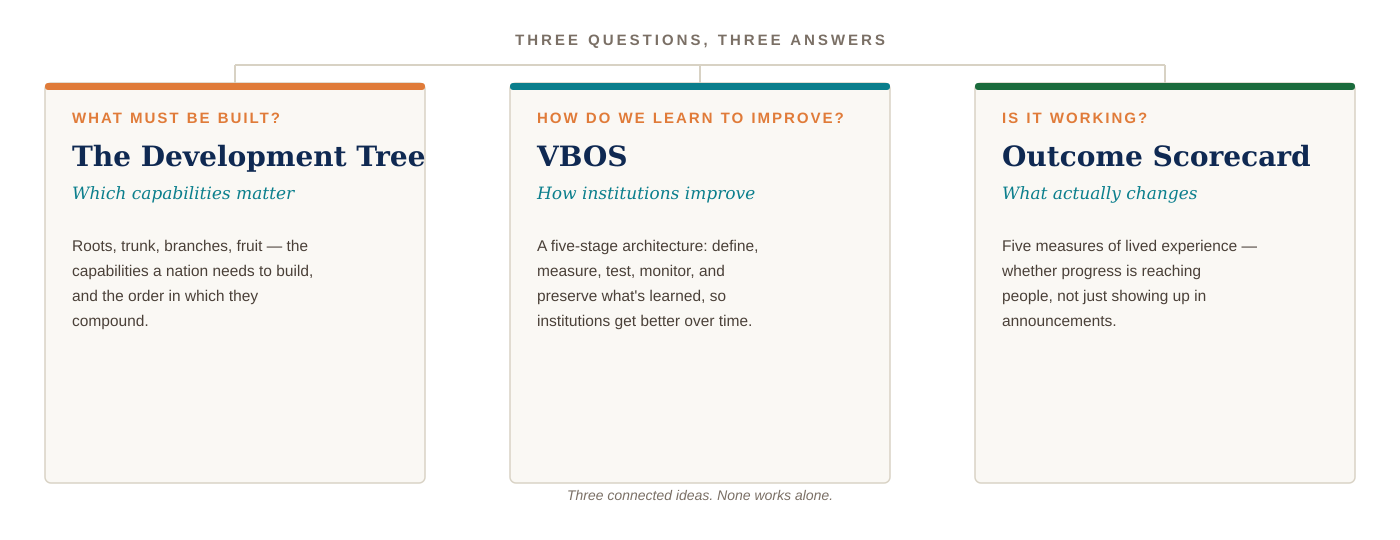
Three questions, three answers, working together.
None of the three works alone. A country can identify the right capabilities and still lose them without a way to learn. It can build strong feedback loops and still miss whether people's lives are actually improving. Development is what happens when all three work together, not three separate efforts.
Without an operating system, development stays a collection of schemes. With one, it becomes a system built to learn.
VBOS, in Five Stages
VBOS is not abstract. It has a shape: five stages that recur in any institution capable of improving over time.
| Stage | Core Question |
|---|---|
| 1. Problem Definition | Are we solving the right problem? |
| 2. Metric Design & Accountability | How will we know whether we're succeeding? |
| 3. Evidence Before Scale | What does the evidence tell us before we expand? |
| 4. In-Flight Monitoring at Scale | What are we learning while implementation is underway? |
| 5. Institutional Memory | What survives after the programme, and its leaders, change? |
Each stage is being developed further through field research and pilot work. The full methodology is not yet public. What's here is enough to show that VBOS has real, specific shape, not just an idea in the abstract.
The VBOS Diagnostic Score
The five stages become more useful once they turn into a structured way of assessing a real programme, policy, or institutional plan. This is that instrument, deliberately named a diagnostic score, not a readiness score or a certification. A diagnostic score describes a structured way of assessing whether certain conditions have been addressed. It does not yet claim to know what a given score predicts about how a programme will perform.
Each question below is scored: 0 (not addressed), 1 (partially addressed, something exists but is incomplete or informal), or 2 (fully addressed, clearly and specifically satisfied). Each stage totals a maximum of 10 points across its five questions.
Before Launch vs. At Review — What Each Stage Requires
Not every stage requires the same thing before a programme launches. Stages 1 and 2 must be fully complete: the problem is defined, the metrics are named, and accountability is assigned, before a single rupee is spent. A programme that cannot pass Stages 1 and 2 at launch has not yet earned the right to proceed, regardless of how promising it sounds.
Stages 3, 4, and 5 work differently before launch. What's required at that point is the design and the commitment, not the completed activity. A plan scores well on Stage 3 before launch by having committed, in writing, to a testing approach, not by already having pilot results, since the pilot hasn't happened yet. Stage 4 scores well by having a named monitoring entity and defined triggers ready to go, not by already having filed quarterly reports. Stage 5 scores well by having a clear requirement and a named owner for the eventual lessons document, not by having already written it.
This is why the instrument is designed to be used more than once: once before launch, to assess whether a plan is ready to proceed, and again at any major review point, closure, a scheduled evaluation, a request for continued funding, to assess whether Stages 3, 4, and 5 were actually carried out as designed, not just planned.
1. Problem Definition — Are we solving the right problem?
| Question | Score |
|---|---|
| Is the problem defined as a measurable gap, not a general aspiration? | 0 1 2 |
| Is the specific population it's meant to help clearly identified, not just "citizens" or "students" in the abstract? | 0 1 2 |
| Is there a clear, stated reason why this intervention should produce the intended result, not just an assumption that it will? | 0 1 2 |
| What would happen to that population if this programme or plan didn't exist at all? | 0 1 2 |
| Has anyone reviewed what earlier, similar efforts in this same space actually revealed? | 0 1 2 |
| Stage 1 total | ___ / 10 |
2. Metric Design & Accountability — How will we know whether we're succeeding?
| Question | Score |
|---|---|
| Are there at least three real outcome metrics, not just inputs (funds released) or outputs (people enrolled)? | 0 1 2 |
| Does each metric have one specific, named person accountable for it, not a department or committee? | 0 1 2 |
| Is there a minimum threshold defined in advance, below which the plan is required to be reviewed? | 0 1 2 |
| Will results be reported on a public, predictable schedule? | 0 1 2 |
| Can the results be verified independently, not just self-reported by whoever is running the programme? | 0 1 2 |
| Stage 2 total | ___ / 10 |
3. Evidence Before Scale — What does the evidence tell us before we expand?
| Question | Score |
|---|---|
| Is there a structured way to test this before scaling, such as a geographic pilot, a time-bound cohort, or a defined review point, rather than launching everywhere at once? | 0 1 2 |
| Are the criteria for deciding whether to scale written down in advance, not decided after the fact? | 0 1 2 |
| Is there a commitment to publish or independently review results before the scale decision is made? | 0 1 2 |
| Is whoever is testing or piloting the idea independent of whoever implemented it? | 0 1 2 |
| Would a negative result be reviewed as openly as a positive one? | 0 1 2 |
| Stage 3 total | ___ / 10 |
4. In-Flight Monitoring at Scale — What are we learning while implementation is underway?
| Question | Score |
|---|---|
| Is there a named, independent entity actually monitoring this, with real access to what's happening on the ground? | 0 1 2 |
| Are the specific conditions that would trigger a redesign, a pause, or a termination written down in advance? | 0 1 2 |
| Are those trigger points fixed at launch, rather than something that can be quietly moved later? | 0 1 2 |
| Is outcome reporting happening on a regular, resourced schedule, not only when someone asks? | 0 1 2 |
| Is that reporting actually made available to the people who'd need to act on it? | 0 1 2 |
| Stage 4 total | ___ / 10 |
5. Institutional Memory — What survives after the programme, and its leaders, change?
| Question | Score |
|---|---|
| Is a lessons document required when this programme closes or comes up for major review? | 0 1 2 |
| Is that document produced or reviewed by someone independent of whoever ran the programme? | 0 1 2 |
| Is there a real place where that document is stored and made accessible to whoever designs the next one? | 0 1 2 |
| Would the next programme designer in this same domain actually be required to look at it first? | 0 1 2 |
| Is one specific person responsible for making sure that document gets written and stored at all? | 0 1 2 |
| Stage 5 total | ___ / 10 |
Diagnostic score: ___ / 50 (sum of all five stage totals)
A worked example, using a hypothetical programme. Consider a fictional state skilling scheme, "Skill Connect," aimed at improving youth employability.
On Stage 1: the scheme names "youth employability" as its goal, but doesn't specify which youth, which sectors, or a baseline gap (0). It has identified a rough target population, unemployed graduates aged 18–25 in three districts (1, not 2, since sectors and a specific baseline are still missing). It offers no written explanation of why the training offered should lead to employment (0). It has not stated what would happen without the scheme (0). It has not reviewed lessons from three earlier, similar schemes in the same state (0). Stage 1 total: 1 out of 10, well below what the diagnostic would consider adequately defined.
This is illustrative only. It shows how the rubric applies, not a claim about any real programme.
What Is Established, and What Isn't
- The core architecture (five stages, three connected ideas) — our current design proposition.
- The 0/1/2 rubric — a deliberately simple, universal diagnostic convention.
- The criteria (the 25 questions above) — hypotheses about what institutional readiness requires, open to challenge.
- Aggregate thresholds (what a total score of, say, 34/50 actually means, or should lead to) — not yet published. This is where pilot evidence matters most, and where we don't yet know enough to make a claim.
- Domain-specific operational metrics — expected to evolve by sector and context as pilots proceed.
- Predictive validity (whether a higher score actually corresponds to better outcomes) — something only pilots, not design, can establish.
VBOS does not yet claim to know what it has not yet learned. The architecture, the rubric, and the criteria are public because they're ready to be challenged. The thresholds stay open because calling them settled before the evidence exists would be exactly the kind of premature certainty VBOS asks institutions to avoid.
Try This With Your Own Plan
If you have an implementation plan, policy document, or scheme you're working on, you can put it to the test.
Point an AI assistant like Claude or ChatGPT to this page (august152047.in/vbos), or paste the five stages, the questions, and the scoring rubric above directly, along with your plan, and ask it to walk through each stage and generate a diagnostic score.
A sample prompt to get started
You'll get a real diagnostic score, out of 50, and a genuine qualitative read of where the plan is strong and where the gaps are. What that score means in absolute terms, whether it's "good enough" to proceed, is something we're deliberately not telling you yet, since that's exactly what pilots are for.
Results vary by tool. Feel free to test it on different tools.
Seeing the Stages Applied
The five stages are meant to travel across very different kinds of programmes. Two illustrations, at different levels of government:
Designing a Talent-Scaling Programme Under VBOS
Consider a national internship or skilling programme aiming to improve youth employability. Under VBOS's Stage 1, the design would begin by specifying which youth, in which sectors, against what baseline employability gap, and toward what employment outcome within what timeframe, rather than a general goal like "improving employability." Under Stage 3, the programme would run a defined pilot (a geographic cohort or time-bound group), with results independently reviewed before any national rollout decision, rather than scaling immediately on the strength of the announcement alone. Under Stage 5, whatever the pilot reveals, including setbacks, would be documented and made available to whoever designs the next programme in the same domain.
Designing a State Urban Service Delivery Programme Under VBOS
Consider a state government programme aiming to improve municipal service delivery, whether water supply, sanitation, or grievance resolution, across its cities. Under VBOS's Stage 1, the design would specify which cities, which services, against what baseline reliability, and toward what specific standard within what timeframe, rather than a general commitment to "improving urban services." Under Stage 2, metrics like median grievance resolution time or percentage of households receiving scheduled water supply would each have a named accountable official, not a department. Under Stage 4, a monitoring entity independent of the municipal corporation itself would track progress quarterly, with pre-defined triggers for redesign if service levels don't improve. Under Stage 5, whatever the programme learns, in this city or that one, would be documented for whichever city government designs the next similar initiative.
The National Outcome Scorecard
VBOS asks whether institutions are getting better at what they do. The Outcome Scorecard asks a different question: is development actually producing better lived outcomes, for the people it's meant to reach.
The scorecard looks across five dimensions:
- Job Quality — the strength of the pathway from credential to career.
- Economic Security — resilience to income and health shocks.
- Urban Livability — whether basic services keep pace with growth.
- Economic Friction — how easily a venture can start and operate.
- Productivity Competitiveness — the feedback loop between capability and demand.
As with the VBOS Diagnostic Score, the detailed indicators, weighting, and scoring methodology behind each dimension are being developed through field research and co-design with institutional partners. Not yet public. If you'd like to know more, reach out.
Guiding Principles
VBOS rests on a small number of commitments, each addressing a specific way institutions typically lose capability over time.
Think in decades, not news cycles.
Institutions built to answer this quarter's crisis rarely build the capability that matters twenty years from now. The work that compounds is usually the work nobody was in a hurry to finish.
Build capabilities, not just programmes.
A programme delivers an output and ends. A capability compounds, strengthens with time, and outlives whoever happened to launch it. Confusing the two is how nations stay busy without getting anywhere.
Protect institutional focus.
Every new priority a system takes on is quietly a decision about what an existing institution now has less room to finish. Attention, unlike capital, cannot be borrowed back once it's spent elsewhere.
Learn continuously from evidence.
Waiting for failure to become undeniable is itself a choice, usually the most expensive one available. Real learning happens early enough to still change the outcome.
Preserve institutional memory.
Every leadership transition risks resetting what an institution already knows. What isn't deliberately kept is rarely remembered, so the same mistake returns, wearing a different name.
Measure what truly matters.
Outputs are easy to count and easier to announce. Outcomes take longer to show and harder to claim credit for, which is exactly why they're the ones most often left unmeasured.
How This Is Being Tested
An idea like VBOS is only useful if it holds up outside a page like this one. It is being tested, not announced.
The work is organized around a single hypothesis, examined in four domains rather than one:
- Adaptive Governance (Roots) — how state and local institutions define problems, learn, and improve.
- Talent Scaling (Trunk) — how education and skilling systems connect capability to real opportunity.
- Industrial Capability (Branches) — how research and innovation convert into industrial and economic strength.
- Lived Development Outcomes (Fruit) — how progress is actually experienced, not just reported.
These are not four separate efforts. They are four tests of the same underlying question: does institutional learning capability, more than talent or capital, determine whether ambition becomes outcome. Each domain is where VBOS gets specified, challenged, and, where it doesn't hold up, revised.
This is, in a sense, VBOS practicing what it argues for. A framework proposing that institutions define, test, learn, and revise should be built the same way: not announced complete, but developed in the open, through real partnerships, and revised as evidence comes in.
We are in active conversation with institutions and research partners about co-designing and piloting VBOS across each domain.
An Evolving Framework
VBOS is being shaped by four years of field visits to colleges and institutions across India (conversations that began with individual career readiness and increasingly surfaced a deeper, institutional pattern), alongside comparative study of how South Korea, China, and other nations have built lasting institutional capability, and ongoing conversations with researchers, educators, and institutional leaders across the country.
VBOS is an initial framework designed to be strengthened through application, evidence, and institutional learning: the same discipline it asks of every institution it examines.
VBOS — First Edition (2026)
Where This Work Is Going
This work continues through research, field partnerships, and writing, including a forthcoming book exploring the institutional architecture Viksit Bharat 2047 will require. VBOS will keep developing alongside it, in the open, over the years ahead.
If you're a state or central government institution, or a private organization, interested in a co-design or pilot opportunity with VBOS, reach out.
VBOS is developed by Vasu Eda, Founding Director of the August 15, 2047 Project, as part of ongoing research into India's institutional learning gap.